Saturday, July 17, 2010

Bird Songs

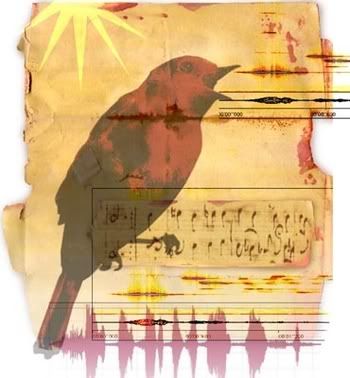
The image above is by Rowena Dugdale. To see more samples or commission her work, go here.

When I put up my last For a Song feature, I wasn’t planning to make it bird week on Oliver di Place. But birds are nature’s musicians, so it only makes sense that they would be an inspiration to songwriters. And some wonderful (human) music has come from this. So, for this, you won’t even need binoculars. Let’s have a look.

Gordon Bok: The Maiden in Bird‘s Plumage

[purchase]

Birds turn up in traditional song all the time. Some are omens, others, sacred messengers, and still others are lovers. The Maiden in Bird’s Plumage is a Danish folk song, but it shares many features with Celtic myth and legend. The story begins with a man hunting a white hind. In Celtic lore, this is a marker, warning the listener that this will be a tale of magic, and so it is here. Soon enough, the hind transforms into a falcon. Then the hero meets the son of the forest lord, who tells him that this is an enchanted maiden, and he explains how to break the spell. Celtic lore has many tales like this, and many of them were probably sung by the bards in olden days, but this is the first time I have heard a tale like this set to music. It works beautifully.

Emmylou Harris: Little Bird

[purchase]

Little Bird is performed by Emmylou Harris, but it may sound like someone else to you, That’s because the song is a cowrite between Harris and Kate and Anna McGarrigle. The sisters also contribute background vocals, and Kate plays accordion. Still the song suits Harris well. The bird is a messenger, to let a man know of her love, and Harris makes this one tender and completely convincing.

Dolly Parton: Raven Dove

[purchase]

Raven Dove is a prayer. Dolly Parton believes in a Heavenly savior, and here the bird becomes a messenger from God, delivering a promise of peace. This one has just enough gospel trimmings, but with a wonderful mostly acoustic arrangement, featuring mandolin and dobro.

Joni Mitchell: Black Crow

[purchase]

Of course, Black Crow was going to be in this set. If you know the song, don’t listen to it just yet. First imagine in your head the drum part. Got it? Good, now listen. Maybe you noticed, there is no drum part. But the drive of Joni Mitchell’s rhythm guitar part certainly makes it feel like there is. In arranging this, I’m sure Mitchell knew that a drum part would anchor the song and hold it in place. But Mitchell’s narrator sees a black crow in flight, and notices that it is far from it’s nest, perhaps even lost. It reminds the narrator of her own feelings of being adrift. So there are no drums, and the bass part catches the air currents, and does not anchor the song either.

Spotlight Song of the Week:


Kara Suzanne: Madeliene

[purchase]

Kara Suzanne sings in an alto voice with a bit of a sob in it. This serves her bluesier material well. The arrangements on Parlor Walls range almost from folk to rock in its various guises. Suzanne can modulate her voice to suit each song, so she is free to write in a variety of styles, with even a hint of country here and there. She shows herself to be a wonderful writer, skilled at capturing character and mood without resorting to cliché. All of this is on display in Madeliene, which also features the most subtle use of horns I have ever heard.
Friday, January 16, 2009

I Love/Hate 70s Music


I have very mixed feelings about the “popular” music of the 1970s. On the one hand, here is a list of some of the my all time favorite albums, which I will probably have more to say about in future posts: Dixie Chicken by Little Feat, The Hissing of Summer Lawns by Joni Mitchell, Late for the Sky by Jackson Browne, The Royal Scam by Steely Dan, Working Man’s Dead by the Grateful Dead. All were released in the 70s. But, I would say, none of these represents the trends in popular music of the decade. All but the Steely Dan album occupied low chart positions if they charted at all. And Steely Dan never inspired many imitators, because their music was too complex.

The music trends of the 70s, to my ear, involved taking something good and true, and turning it into mush. The Beatles experimented with distortion and other new guitar sounds, as did the blues-rockers of the 60s; in the 70s, this morphed into the excesses of hard rock and heavy metal. The great energy of funk became the robotic formula of disco. The fusion jazz that Miles Davis invented became formulaic, and edged out musicians playing other types of jazz from the spotlight. The early honesty of the singer-songwriters became cliche ridden, and honest feeling became overwhelmed by insipid productions involving cookie-cutter string parts.

All of these things were symptoms of one thing: the emphasis in the music business went from music to business. People who had risen in the ranks of the major labels, driven by their love of the music, began to be edged out by people with business backgrounds but no particular interest in the music for its own sake. The labels themselves started to become part of larger corporations, and the bottom line began to take over. The most popular artists began to receive the most expensive productions, whether it served the music or not.

At the end of the decade, there was a backlash which gave the world punk rock. This, and the rise of MTV in its original form, would loosen things up, and the 80s would be somewhat better. But, to my ear, a random selection of greatest hits of the 70s contains more bad music that any other decade.

As I have gotten older though, I have come to realize something: not all of the bad music of the 70s consisted of bad songs. Sometimes, a cover version reveals that the song was never the problem at all; rather, it was something about the performance or the production.

Dolly Parton: Stairway To Heaven

[purchase]

I am well aware that many people love Led Zeppelin. The very qualities that they so admire are the ones that send me to the exits. I find Robert Plant’s screaming vocals painful to listen to, especially knowing that he has a great voice when he chooses to sing with more subtlety. And the same goes for the scream of the guitars, again knowing that these musicians can do brilliant things when they choose to play with more subtlety. So nothing is more aggravating to me than Stairway to Heaven. The song begins with all of good qualities on full display. Then, we get to the bridge, and disaster strikes, and the screaming begins.

But Stairway to Heaven is a great song. Dolly Parton, (of all people!), finds all the qualities in the song that I always liked, and does not sabotage them as Led Zeppelin does. And she does this in a bluegrass treatment that really works. Ironically, Dolly Parton is one of those people whose 1970s output was much afflicted with many of the problems I discussed above.

k d lang: Helpless

[purchase]

I am also aware Neil Young is an idol to many. And I can appreciate his talent as a writer. Furthermore, what I have heard of his 70s output is not marred by many of the qualities I discuss above. I just can’t stand his voice. If you’ve ever gotten a fax machine on the phone by mistake, and had your ears assaulted by that high pitched squeal, you have an idea how I feel about the falsetto that Neil Young used on songs such as Helpless early in his solo career. And even his natural voice, which I have heard more and more as he gets older, bothers me.

k d lang is an artist who was demonstrated, with her song Summer Fling, that she has a weakness for some the worst excesses of 70s production. Indeed, her version of Helpless swells at the chorus, and the strings come in and almost ruin what is a nice subtle arrangement on the verses. But this is not the wall of strings that overwhelms everything in a 70s production; here, the listener can distinguish the individual string parts and the other instruments. And, of course, k d lang possesses one of the finest voices in popular music.
