Wednesday, November 4, 2009

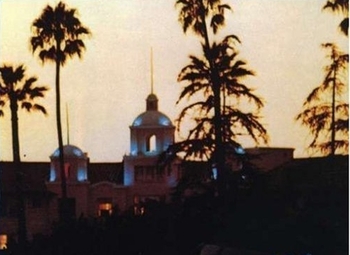
For a Song: Hotel California


The Eagles: Hotel California

[purchase]

It’s probably true that most of my readers have never wondered if I like the Eagles. But the answer is usually no. There is, obviously, one exception. Hotel California. I should say that the only music of theirs I ever heard was whatever made it onto the radio, so they may have done other songs I would enjoy. But this is the only one I know.

Hotel California came out at an interesting time. In the 1970s, psychedelic rock morphed into progressive rock, and then faded away. Reggae arrived in the United States, and made a big impression on some people, but never achieved consistent commercial success. The Eagles ruled the airwaves with a mix of country rock and hard rock.

Culturally, the 1970s were about the belief in magic. The works of J R R Tolkien found a mass audience. Star Wars was huge. (I know Star Wars takes place in space, but in theme and plot as well, it is fantasy, not science fiction.) A remake of The Wizard of Oz, (remember The Whiz?), was a Broadway hit. And something called magic realism was coming from novelists in Latin America.

Hotel California is neither country rock nor hard rock. It is related rhythmically to reggae, but the arrangement is hard rock. Like so many songs of that vintage, Hotel California has been covered many times. But the covers of Hotel California include reggae, flamenco, and gypsy versions. It’s almost surprising that this unusual rhythm made onto mainstream radio in the first place.

Then there are the lyrics. Hotel California tells the tale of a man who is traveling through an area that is unfamiliar to him. Seeking a place to stay for the night, he comes upon the title establishment. He decides to stay for the night, only to learn that, “You can check out any time you like, but you can never leave.” Described this way, it sounds fairly mundane. But why can he never leave? The lyrics never say. There are strange behaviors here, some of which sound like rituals, (“they stab it with their steely knives”). So, although nothing magical is spelled out, I have always taken this to be a tale of magic. Beyond that, the song is a mystery. My interpretation changes every time I hear the song. And that is what I treasure about it. But I still feel weird about liking anything by the Eagles.
Friday, January 16, 2009

I Love/Hate 70s Music


I have very mixed feelings about the “popular” music of the 1970s. On the one hand, here is a list of some of the my all time favorite albums, which I will probably have more to say about in future posts: Dixie Chicken by Little Feat, The Hissing of Summer Lawns by Joni Mitchell, Late for the Sky by Jackson Browne, The Royal Scam by Steely Dan, Working Man’s Dead by the Grateful Dead. All were released in the 70s. But, I would say, none of these represents the trends in popular music of the decade. All but the Steely Dan album occupied low chart positions if they charted at all. And Steely Dan never inspired many imitators, because their music was too complex.

The music trends of the 70s, to my ear, involved taking something good and true, and turning it into mush. The Beatles experimented with distortion and other new guitar sounds, as did the blues-rockers of the 60s; in the 70s, this morphed into the excesses of hard rock and heavy metal. The great energy of funk became the robotic formula of disco. The fusion jazz that Miles Davis invented became formulaic, and edged out musicians playing other types of jazz from the spotlight. The early honesty of the singer-songwriters became cliche ridden, and honest feeling became overwhelmed by insipid productions involving cookie-cutter string parts.

All of these things were symptoms of one thing: the emphasis in the music business went from music to business. People who had risen in the ranks of the major labels, driven by their love of the music, began to be edged out by people with business backgrounds but no particular interest in the music for its own sake. The labels themselves started to become part of larger corporations, and the bottom line began to take over. The most popular artists began to receive the most expensive productions, whether it served the music or not.

At the end of the decade, there was a backlash which gave the world punk rock. This, and the rise of MTV in its original form, would loosen things up, and the 80s would be somewhat better. But, to my ear, a random selection of greatest hits of the 70s contains more bad music that any other decade.

As I have gotten older though, I have come to realize something: not all of the bad music of the 70s consisted of bad songs. Sometimes, a cover version reveals that the song was never the problem at all; rather, it was something about the performance or the production.

Dolly Parton: Stairway To Heaven

[purchase]

I am well aware that many people love Led Zeppelin. The very qualities that they so admire are the ones that send me to the exits. I find Robert Plant’s screaming vocals painful to listen to, especially knowing that he has a great voice when he chooses to sing with more subtlety. And the same goes for the scream of the guitars, again knowing that these musicians can do brilliant things when they choose to play with more subtlety. So nothing is more aggravating to me than Stairway to Heaven. The song begins with all of good qualities on full display. Then, we get to the bridge, and disaster strikes, and the screaming begins.

But Stairway to Heaven is a great song. Dolly Parton, (of all people!), finds all the qualities in the song that I always liked, and does not sabotage them as Led Zeppelin does. And she does this in a bluegrass treatment that really works. Ironically, Dolly Parton is one of those people whose 1970s output was much afflicted with many of the problems I discussed above.

k d lang: Helpless

[purchase]

I am also aware Neil Young is an idol to many. And I can appreciate his talent as a writer. Furthermore, what I have heard of his 70s output is not marred by many of the qualities I discuss above. I just can’t stand his voice. If you’ve ever gotten a fax machine on the phone by mistake, and had your ears assaulted by that high pitched squeal, you have an idea how I feel about the falsetto that Neil Young used on songs such as Helpless early in his solo career. And even his natural voice, which I have heard more and more as he gets older, bothers me.

k d lang is an artist who was demonstrated, with her song Summer Fling, that she has a weakness for some the worst excesses of 70s production. Indeed, her version of Helpless swells at the chorus, and the strings come in and almost ruin what is a nice subtle arrangement on the verses. But this is not the wall of strings that overwhelms everything in a 70s production; here, the listener can distinguish the individual string parts and the other instruments. And, of course, k d lang possesses one of the finest voices in popular music.
