Thursday, September 23, 2010

For a Song: A Tree On Allenford


Rickie Lee Jones: A Tree on Allenford

[purchase]

Rickie Lee Jones first burst on the scene with Chuck E’s in Love, an infectious bit of folk-pop that was a huge hit. But, with her second album Pirates, Jones began dismantling her popularity, while wowing the critics. I would describe her music from then on as a pop/ art song hybrid. The lyrics have been poetic, and the arrangements have sometimes stretched the usual song structures beyond recognition. The orchestrations and the use of dynamic shifts have showed Jones to be a truly original artist. Only most of this works, but when it does, the results are spectacular.

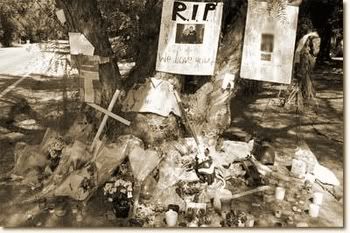
Consider A Tree on Allenford. The first thing you hear is an English horn, soon to be joined by a clarinet. Later there is a harmonica playing what almost sounds like an accordion part. So the overall sound is like a slightly off kilter cabaret song. On top of this, Jones delivers a beautiful lyric. Her narrator sees flowers left at the base of a tree, in remembrance, probably, of a child who died there. This leads to a meditation on the notion that everyone and everything is loved by at least one other person. So this is a love song, but not in the usual sense. You notice all of the unusual qualities, but they all serve the song beautifully. Rickie Lee Jones is blonde, plays guitar and piano, and is influenced by jazz music. So she got compared to Joni Mitchell a lot when she first came on the scene. By the time Jones recorded A Tree on Allenford, the comparison was clearly absurd. Instead, Jones is a true original, and one of our finest songwriters and musicians.


Friday, July 24, 2009

Quotable Lyrics


A song can make a strong first impression in a number of ways. The most obvious is probably a strong hook; a phrase in the instrumental line grabs you before the song is even fully underway. Sometimes a distinct vocal sound will do, especially if you are hearing an artist for the first time; Bob Dylan is the classic example of this. But there are times when the thing that stays with me is a line of the lyrics; this often takes the form of “did s/he really just say that?” Let me give you some examples.

Rickie Lee Jones: Danny‘s All Star Joint

[purchase]

Danny’s All Star Joint was on Rickie Lee Jones’ debut album from 1979. At that time in my life, it sounded like a great place to hang out. I could see in my mind the pinball machines flashing. There would be a magazine rack with the latest comics, (there were no specialty comic book shops in those days). And there would have to be a lunch counter, hence the line, “Carte blanche sandwich, oh lettuce get thick!” If, in a moment of madness, I ever decide that I need to have another blog, I’m going to call it The Thickening Lettuce.

John Hiatt: Trudy and Dave

[purchase]

John Hiatt is one of the most quotable songwriters I know. This is the man who rhymed Queen of Sheba with amoeba in Thing Called Love. But here is my favorite line of his: “stole the money for the laundromat and drove away clean.”

Steely Dan: Everything You Did

[purchase]

The line here is, “turn up the eagles, the neighbors are listening”. I used to think that there were these two eagle statues in the room with volume knobs that emitted some sort of white noise. This didn’t make much sense, so I kept thinking about it. My next thought was that the song took place outside of Philadelphia, and the football game was on. This was better. But the most likely explanation was that a song by the Eagles was on the radio or the stereo. Ironically, the characters in this song don’t strike me as the type to listen to Steely Dan.

Lyle Lovett: Church

[purchase]

Lyle Lovett is not afraid to write a song about something bizarre, and here is my favorite example. A gospel number about hunger, the climax of the story is the sudden appearance of a dove in the church. Referring to the preacher, Lovett sings, “...the dove flew down beside him, and a fork appeared right in his hand...”, and the conclusion, “...everyone got really nervous.”

Talking Heads: Seen and Not Seen

[purchase]

David Byrne has never been afraid to be bizarre. Sometimes he carries this tendency too far, and it almost becomes self-parody. But, when he hits it right, as he does here, Byrne becomes an alien observer of human foibles, with much to teach us about ourselves. Seen and Not Seen is about our obsession with changing our appearance. The Line is, “some might have gotten half way there, and then changed their minds.”

Friday, February 20, 2009

Financial Fairy Tales


Once upon a time, people believed:

That tulip bulbs were worth more than houses.

That the price of a house could only go up, never down.

That one man knew a secret which enabled him to beat every other known investment, no matter what the economy was doing.

It’s true. People really did believe these things. And they never thought to ask why or how, until it was too late. In each example, supposedly sophisticated investors put vast sums of money on these beliefs. And in each example, people like you and me, who never had the means to get involved, wound up getting hurt.

So why does this happen over and over, throughout history? I think that, when one of these things gets started, the first investors often know that it is a shell game, but they can still make a killing if they get out in time. Or someone they know brings them in with the simple appeal to “trust me”. Soon the thing gathers momentum, and people get involved based on the idea that serious money is being made, and they are afraid of being left behind. Once that happens, logic flies out the window, and greed completely takes over.

But something always happens, and the whole thing collapses. And many of those who knew that they only had to get out at the right time, didn’t.

It would be so much easier if people would just listen to our storytellers and songwriters. These artists could tell you that, if it seems too good to be true, it probably is. The characters in the songs below “just knew” that they had a surefire plan to make a quick buck. And of course, it wasn’t that simple.

Rickie Lee Jones: Easy Money

[purchase]

Robert Earl Keen: The Road Goes On Forever

[purchase]
