
[purchase]
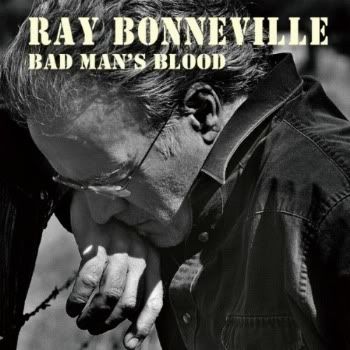
Listening to Bad Man’s Blood, I am reminded of the music of John Lee Hooker. Hooker would set up a groove with just a few notes, and he would stay on those notes for the entire song. The effect was haunting, like an incantation. It was a technique that only worked for Hooker, I thought, but its power was undeniable. Ray Bonneville has a somewhat richer musical vocabulary here, but he achieves some of the same kind of effect. Bonneville casts a spell, and he holds you for the length of the album.
The songs on Bad Man’s Blood are mid-tempo stomps, and stomps is an apt term. Bonneville plays either acoustic or electric guitar on every song, sometimes both. To this he adds what the liner notes call “foot percussion”; basically, this seems to mean that he stamps his foot in time to the music. Mike Meadows is the drummer on some tracks, but this is not drumming as you usually hear it. Meadows is playing a “Black Swan”, which is a tunable hand drum with changeable heads, so you can get a wide variety of sounds from it; here, Meadows is just playing a steady pulse, like a heartbeat. Gurf Morlix plays electric guitar, baritone guitar, bass, and banjo in various places. His role is to thicken the sound and add texture. Also adding to the texture on two songs is Dexter Payne on saxes. And here and there, Bonneville adds smudges of sound on harmonica. These smudges are sort of accidental chords, and their purpose is not melodic at all. They sound like something from another planet, but they make musical sense in context. In sum, the tempos don’t change much on this album, but Bonneville and his crew vary the textures enough to make this a fascinating listen. Bonneville sings in a weathered bluesy baritone. Bonneville knows his limits vocally, but he can imbue the title song with a sense of foreboding, while the affection in Blond of Mine, the sly humor of Funny ‘Bout Love, and the yearning in Darlin’ (Put You Suitcase Down) all come through loud and clear.
There is also a nice variety of themes in the lyrics. Of course, there are love songs. Darlin’ (Put Your Suitcase Down) is what it sounds like, a song about a break up. But Bonneville leaves open the possibility that the Darlin’ in the song might finally decide to stay. Funny ‘Bout Love is about the feelings of a man and a woman who meet years after they stopped being a couple. And Sugar and Riley relates the tale of a lovers quarrel overheard through a wall; Bonneville hastens to assure us in the first chorus that everything was ok again by morning. Other songs are more mysterious. River John sounds like a fond remembrance of a friend who has passed on. Night Walker is a speculation about a stranger who is observed walking around outside night after night; Bonneville’s narrator regards him with intense curiosity, but does not see him at all as a threat. In all of these songs, there is a sense of hope, and abundant sympathy. Bonneville sees the world as full of good people who sometimes get in bad situations.
So, where John Lee Hooker portrayed men in hopeless positions, overcome by their fate, Bonneville uses the same kind of insistent music not to despair but to urge perseverance. Bad Man’s Blood casts a spell, but the darkness never takes over. This album is insistent, but hopeful in hard times. Bonneville’s voice has a smile in it, especially later in the album. I’m sharing that smile right now.
Ray Bonneville: Sugar and Riley
Ray Bonneville: Night Walker


 Posts
Posts




