

I have a tremendous amount of music that I am excited about. Some is by artists I have been following, while some is in the new discovery category, and some is from people who I became friendly with before I ever heard their music. So, when I receive music submissions for Oliver, I often have to set some of it aside for the dreaded later. And while I wish I could get to all of it, for some, later never comes. So this week, I thought that I would pick five artists from the “for later” pile, and call it a set. I cheated a bit by starting with eight albums and whittling it down. Still, here are five artists whose albums I hadn’t gotten to, and who are just as worthy as anyone else I have ever featured.
Update: I had accidentally loaded several of the songs in this post as WMA files. I have now replaced them with the mp3 versions. Thank you to the anonymous reader who pointed this out, and I apologize for the inconvenience.
Allysen Callery: Favourite Son
[purchase]
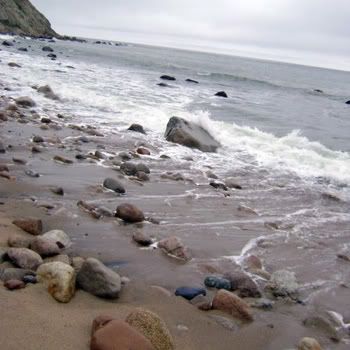
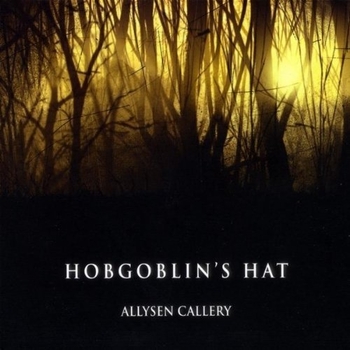
I have featured Allysen Callery before, but her new EP Winter Island got set aside because of the packaging. This one was issued in a limited addition, and it came in a plastic sleeve inside a cloth pouch. It didn’t fit safely on my CD pile, so I set it aside. But Allysen Callery and Winter Island deserve better. Until now, I have only heard Callery with a full band behind her. I admired her quiet intensity, and the folkloric quality of her writing. But here she is solo, just her voice and guitar. And this setting is a revelation. The first thing I noticed is that Callery is a fine finger style guitar player. Her playing tends to blend in in a group setting, but here she shines all on her own. I am reminded of what the ancient Irish believed about their bards. It was said that a bard could cast a spell with just his harp playing and his voice, and the spell would transport the listeners to another world while the song played. Most but not all of the listeners would make it back when the song ended. Callery displays that kind of otherworldly ability here, and Favourite Son is a fine example.
Giant Cicada: Gonna Get Through
[purchase]
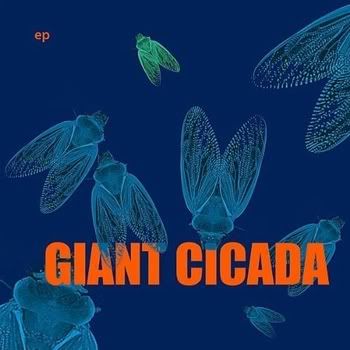
Giant Cicada is a group that makes music in the cracks. Is this jazz, folk, Americana, what? Some of my favorite music doesn’t fit neatly in any genre, and I will add this to the list. The rhythm section of this band is a cajon, (a hand-played box drum), and bowed bass. On top of this, add guitar, fiddle, and the wonderful vocals of Lynn Stein. There is also bottleneck guitar on some tracks. Gonna Get Through has a Brazilian lilt, both in the playing and in Stein’s vocal. But the song also has the propulsive drive of 80s rock. Giant Cicada’s gift is to take these incongruous elements and have them make sense together. Stein is an emotional singer who never has to shout, and that really puts this album over the top.
Anthony Walker: Forget the Railroad
[purchase]
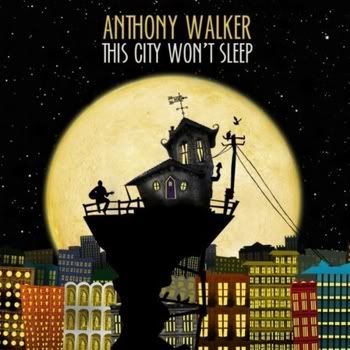
Anthony Walker’s new album This City Won’t Sleep was the last album I grabbed for this post. It was still in its shrink wrap, and I knew I must have heard something I liked, but I couldn’t remember why I requested it. Now I do. Walker sings in a high tenor that is an excellent rock instrument. Many of the songs here do in fact rock out, and it’s a great sound. But for me, the quieter songs are the standout tracks. That’s because they focus your attention more on the lyrics, and Walker is a great storyteller. Forget the Railroad seems to be set in the here and now, but Walker provides a line of flashback here and there, and pretty soon the listener can fill in the history of a relationship. Probably, no two listeners would tell it quite the same way, but all of the essential details are here. Walker gives all the clues, and he makes you want to fill in the details. That’s a pretty good definition of fine songwriting.
Postcard Comets: The Guardhouse and the Moon
[purchase]
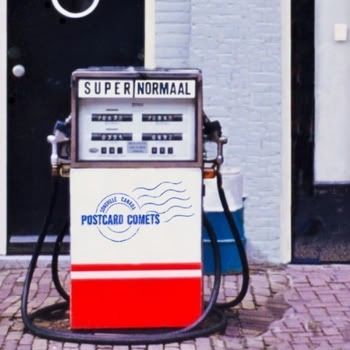
I first met David Partridge of Postcard Comets quite some time ago, in an online song review group, and later in an acoustic music forum. Many of the people who are to be found in these places are amateur musicians, trying to get better at what they do and maybe make an album some day. But not Postcard Comets, at least not by the time I met them. Their music stood out, it because it was ready for the big(ger) time. I remember that, but I didn’t remember exactly what it sounded like. So when Partridge offered me their new album for the blog, I knew I wanted it, but I didn’t remember why. Now I remember.
Postcard Comets is the duo of Partridge and Buck Wilburn. Between them, they play seven instruments by my count, so the sound on the album is that of a full band. Partridge does most of the writing, and he is an expert scene setter. In The Guardhouse and the Moon, I can see that night sky as I listen, and I can feel that cold autumn breeze blowing on me. Partridge’s voice has the texture of fine sandpaper, but he knows how to use that to his best advantage. Wilburn contributes a great part on lead acoustic guitar, with something of a Spanish flavor. All told, the emotion of this song comes through loud and clear. The subject is two childhood friends parting, as one begins military service. There are not all that many songs on this subject, so Partridge shows himself to be not only an evocative songwriter, but also a true original. The Guardhouse and the Moon is no fluke either; there are many other gems to be found on this album.
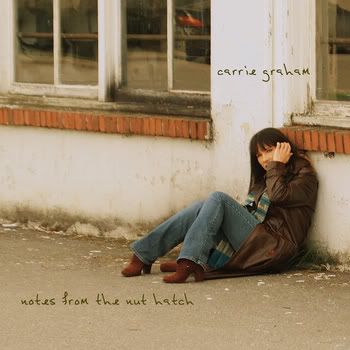
Carrie Graham: Mirrors
[purchase]
I met Carrie Graham in that same acoustic music forum I referred to above. She sent me her EP Notes From the Nut Hatch just over a year ago. So why did it take me so long to get to her? Graham’s EP is only available as a download, so it has sat on my hard drive all this time, waiting for me to remember that it was there. It was knowing that I would be posting Postcard Comets that reminded me. So, Carrie, I’m sorry this took so long.
Graham sings in a slightly breathy low alto, and it’s a great sound. She writes little unsettled love songs, and her performances perfectly portray these feelings. The rest of the songs on Nut Hatch fall loosely into the Americana category, and Graham does that very well indeed. But Mirrors is something else again. This one has a stuttery rhythm and great atmosphere. The narrator might have been transported to the Otherworld by Allysen Callery’s bardic arts, and now she seeks her way back through love. That might sound corny, and it probably isn’t exactly what Graham had in mind. But the song really works. The purchase link above will take you to Graham’s Bandcamp page, where you can purchase a download of Nut Hatch. There is also a link on the sidebar to a new song. Graham’s writing continues to develop, and her originality increases. I hope that there is a full length album in the future, and I hope I can get it as a physical CD, so I can share it here in a timely manner.
*******************************************************
One last thing: I would like to congratulate Teresa Storch on the success of her Kickstarter campaign. To all of my readers who were able to help, thank you.




 Posts
Posts




